
WITCHOPS / SAMPLE DELIVERABLE
CI/CD Pipeline Diagnostic
Sample Report
Demonstration only. Synthetic example, not an actual customer assessment.
Fictional scenario: Northstar Demo, GitHub Actions to Azure. Report reference WO-SAMPLE-001 · edition 1.0.
Download the sample report PDF ↗01. Executive summary
This example illustrates how a scoped review can connect delivery configuration to operational decisions. Four fictional findings identify two high-priority control gaps and two medium-priority reliability gaps. Nothing here represents a live customer assessment.
02. Assessment scope
One fictional repository and one delivery pipeline, with a three-hour review-and-reporting budget. Inputs are synthetic workflow excerpts, a fictional identity inventory and a deployment outline. No production access, changes or remediation are included.
03. Illustrative environment overview
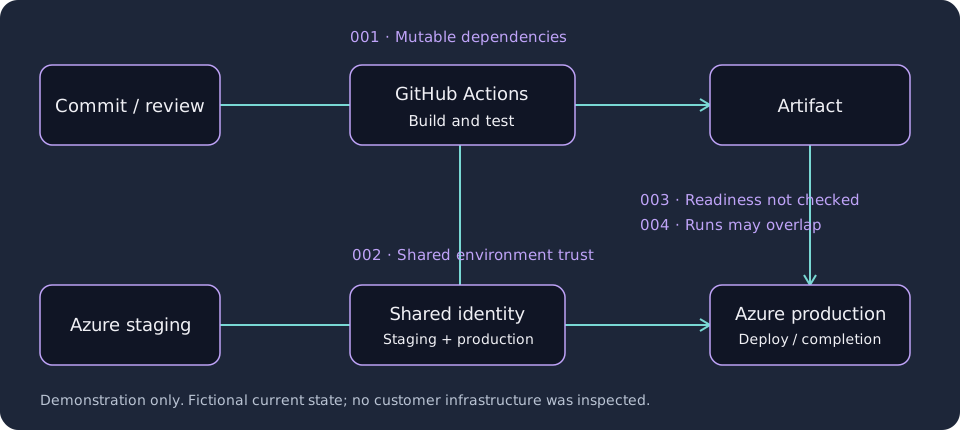
A fictional team builds an application in GitHub Actions, publishes an artifact and deploys to Azure. Staging and production share an illustrative identity. Workflow dependencies, deployment sequencing and readiness verification require review.
04. Pipeline architecture
05. Example findings
WO-PD-001 · HIGH
Unreviewed workflow dependencies
Potential impact: A change outside the repository could alter build behavior without a local review.
Example evidence: E-01: example workflow references actions/checkout@main.
Illustrative root cause: The example has no recorded action-dependency pinning or update policy.
Recommended action: Pin external actions to reviewed immutable revisions and establish a controlled update process.
WO-PD-002 · HIGH
Production identity crosses environment boundaries
Potential impact: A staging workflow could reach production resources if its permissions and trust permit it.
Example evidence: E-02: the illustrative inventory assigns one deployment identity to staging and production.
Illustrative root cause: Environment ownership and identity boundaries were not defined separately.
Recommended action: Separate environment identities; validate least privilege and narrowly scoped federation trust before rollout.
WO-PD-003 · MEDIUM
No bounded deployment verification
Potential impact: A completed command could be mistaken for a healthy application; a stalled job could consume runner time.
Example evidence: E-03: the example deployment job ends after a deployment command and has no timeout or readiness check.
Illustrative root cause: The pipeline contract ends at deployment rather than verified service readiness.
Recommended action: Define a job timeout, bounded readiness checks, explicit failure output and an agreed rollback decision.
WO-PD-004 · MEDIUM
Concurrent production deployment attempts
Potential impact: Overlapping runs could interleave deployment and verification work, obscuring which release is active.
Example evidence: E-04: the example production job has no environment-specific concurrency group.
Illustrative root cause: The release workflow has no single-writer boundary for the environment.
Recommended action: Serialize deployments per application and environment; review cancellation behavior before enabling it.
06. Severity and business impact
High means review before production use because a release-control or identity boundary may be crossed. Medium means address within planned hardening because observability or sequencing may be unreliable. These are qualitative judgments for this synthetic example; no exploitation or outage was observed.
07. Supporting example evidence
E-01 · fictional workflow excerpt
example/.github/workflows/deploy.yml:14
- uses: actions/checkout@main
# Illustrates a mutable reference; this is not a recommended workflow.
E-02 · fictional access inventory
staging:    identity = shared-deployer
production: identity = shared-deployer
Trust and effective permissions are assumed for this example, not inspected.
E-03 · fictional deployment-job outline
deploy production
exit success
# No timeout or application-readiness verification is declared in this example.
E-04 · fictional workflow inspection note
production job: concurrency group absent
Two deployment runs may overlap in this scenario.
These excerpts demonstrate report formatting. They are not complete workflows, recommended configurations or real exported customer data.
08. Root-cause analysis
The fictional system lacks explicit contracts for dependency ownership, environment trust, release sequencing and completion criteria. The four findings share a process cause: responsibilities and acceptance checks were left implicit. A real root-cause conclusion would require interviews and corroborating evidence.
09. Recommended corrective actions
- Pin external actions to reviewed immutable revisions and establish a controlled update process.
- Separate environment identities; validate least privilege and narrowly scoped federation trust before rollout.
- Define a job timeout, bounded readiness checks, explicit failure output and an agreed rollback decision.
- Serialize deployments per application and environment; review cancellation behavior before enabling it.
Apply changes through review, non-production validation and an agreed rollback path. Confirm effective permissions and runtime behavior separately from static configuration.
10. Prioritized remediation roadmap
| Priority | Work | Suggested owner |
|---|---|---|
| 1 · Contain | Confirm identity ownership and effective access; agree any urgent containment with the customer. | Platform / security owner |
| 2 · Stabilize | Review action revisions; separate environment trust; agree a deployment concurrency policy. | Delivery / platform owner |
| 3 · Verify | Add bounded readiness checks and timeouts; exercise failure and recovery paths in a non-production environment. | Application / operations owner |
| 4 · Reassess | Review resulting evidence and residual risks; agree acceptance criteria before production rollout. | Customer technical owner |
Sequence indicates dependency and urgency, not a calendar commitment. Timing follows access, scope and customer change-control requirements.
11. Assumptions and limitations
- All names, paths, findings and evidence are invented. No real repository, subscription or customer data was accessed.
- Severity is a qualitative prioritization example, not a measured probability or compliance verdict.
- No exploit, incident, production outage or cost saving was observed. Business impacts describe potential consequences.
- No production deployment, permissions test, load test, runtime inspection or remediation was performed.
- A real assessment depends on agreed access and evidence. Static configuration alone cannot establish live security or reliability.
- Implementation, retesting and production changes require separate authorization and scope; a diagnostic does not guarantee a complete repair.
12. Next steps
Confirm the actual environment, agree the diagnostic boundary and access method, then define the evidence needed for each finding. A remediation proposal can follow as a separate engagement.
Email WitchOps